Muzzle brake vs suppressor is a question more hunters are asking as factory rifles increasingly come threaded for muzzle devices. Both tame recoil and help you spot your shots, but they differ dramatically in noise, cost, and convenience. After years of shooting both, one veteran hunter weighs the pros and cons and delivers his verdict.
Story by George Krumm. Originally published in the Spring 2025 issue.

Editor’s note: Since this article was first published in February of 2025, the suppressor industry and National Firearms Act (NFA) process has evolved regarding suppressor purchases and transfers. A federal tax stamp is no longer required, so you save $200. But the rules regarding suppressor transfers, purchases, and ownership vary from state to state. For the first-time suppressor buyer, it may be helpful to buy through Silencer Central or Silencer Shop to eliminate confusion and ensure the process goes smoothly. Some local gun shops are also competent in assisting with purchases and can be the fastest way to get a suppressor in your hands. Some great news: Wait times to get the NFA paperwork approved are down to a few days up to a few weeks.
A Startling Day at the Range
Many years ago, probably in the early 1980s, I had a startling experience at a gun range that was quite eye-opening…and quite disruptive to my shooting. A fellow had set up at the shooting bench next to me. I didn’t really pay him much mind other than to nod a greeting. I went back to my shooting, concentrating on my breathing and trigger squeeze. I was vaguely aware of the guy next to me, who was also preparing to send a round downrange. In those days, we commonly shot with ear muffs. We didn’t have any noise-cancelling stuff though. I’m not sure it existed yet. I was squeezing the trigger when the loudest muzzle blast I’d ever experienced reverberated under the roof of the shooting area. Flinching from his muzzle blast, I jerked the trigger, ruining my shot, and looked over at the guy next to me. I exclaimed, “What in the world are you shooting?” Well, I said something like that, anyway.
“.300 Win Mag,” he replied.
“That’s the loudest rifle I’ve ever heard in my life,” I added.
“Yeah, it’s loud. It has a muzzle brake on it. See the thing on the end of the barrel with the holes in it? I have to wear foam ear plugs as well as my ear muffs when I shoot this baby. But the brake reduces the recoil a lot—like 75%!”
I made a mental note of that. I’m not overly sensitive to recoil, but I’m not superman, either. 20 shots with a 7mm Rem Mag is about my limit on a plain-barreled, 8-pound rifle. In all honesty, at 15 shots the recoil starts getting in my head, so the idea of big-recoil reduction was attractive.
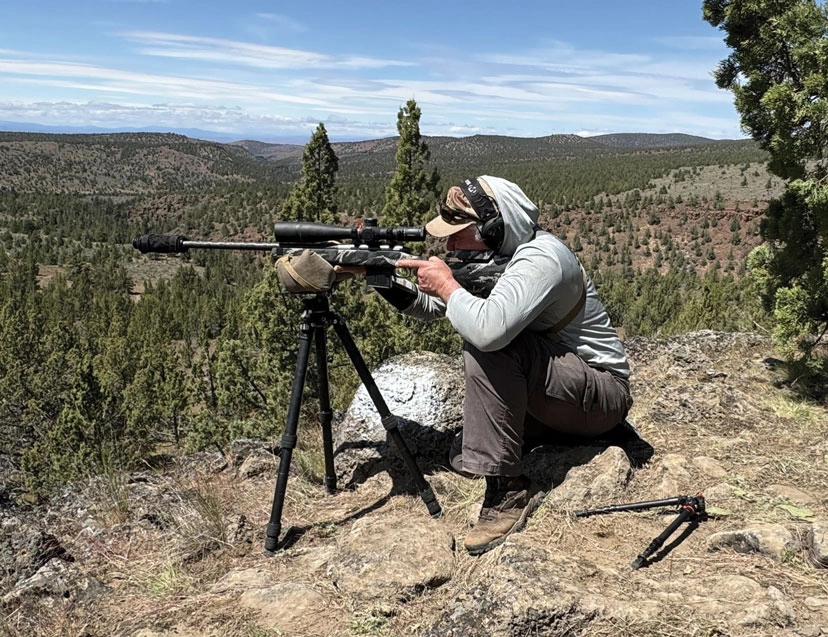
Tom Moyle of Leupold shoots suppressed in a NRL Hunter match. Suppressors reduce the report to hearing-safe levels, and reduce recoil significantly though not as much as a muzzle brake.
Living With Braked Rifles
As the years wore on, muzzle brakes became more and more common. After that first experience, when I went to the range, if I saw someone shooting a braked rifle, I tried to position myself as far from them as possible so their report and muzzle blast didn’t cause me to flinch. I began to avoid ranges on weekends because invariably there would be guys there shooting broken rifles (okay, they aren’t broken; braked is fairer to say). Eventually, I bought a Winchester Model 70, stainless/synthetic .338 Win Mag. It came with a muzzle brake. Later, I bought a Savage 110 Storm .300 Win Mag on which I had a gunsmith thread and install a Holland’s Quick Discharge Muzzle Brake. I loved the recoil reduction of these braked rifles, but hated the noise, concussion, and muzzle blast. Still do. I dread the thought of having a sudden, close opportunity for a shot on game, because I’d probably take it, and might do further damage to my hearing. It really is that bad—much worse than a plain-barreled rifle which propels all the gases and sound in a forward direction, away from you.

A directional muzzle brake from Oregon Mountain Rifle. Three ports is generally enough for a hunting muzzle brake, reducing recoil by roughly 70%.
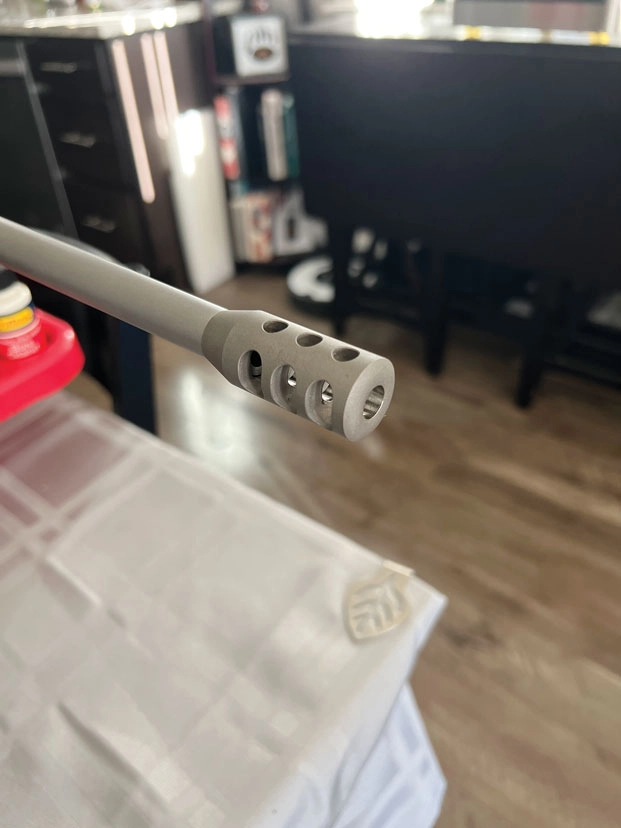
This Holland’s muzzle brake enabled the author to fire more than 20 shots of .300 Win Mag 190-grain ammo in one session with no soreness or discomfort. But be sure you use ear protection!
Muzzle Devices on Today’s Hunting Rifles
Nowadays, many hunters have some sort of muzzle device on their hunting rifles. Factory rifles often come with a muzzle brake, or at least, are threaded so you can attach the muzzle device of your choosing. Muzzle brakes are probably the most common muzzle devices in the hunting world, though in the past five years or so there has been a tremendous increase in the number of suppressors (AKA silencers, AKA cans) sold to hunters in the United States. I am one of them—I own three cans now, with another one on the way.
There are reasons why hunters put muzzle devices on rifles. Mostly, it has to do with comfort, especially regarding the heavy recoil of many big-game calibers. But there are very practical reasons beyond the shooter’s comfort that lead hunters towards using muzzle devices. Let’s take a look at some of the advantages and disadvantages of muzzle brakes and suppressors.
Muzzle-brake advantages
Muzzle brakes have been around for a long time now. There are hundreds of choices out there, and if you have a rifle that isn’t threaded, most likely your local gunsmith can thread it for you for $100 to $200. Muzzle brakes vary quite a bit in size and appearance. Certainly, some look “cooler” than others, kind of like some tires look “cooler” than others. There are radial brakes with many ports in 360 degrees about the device. There are also directional brakes with holes on the sides, and sometimes, on the top to reduce muzzle jump. For the directional brakes, which have some advantages for hunting, the maximum amount of recoil reduction happens with four-port models. However, two-port and three-port models are very close in performance to the four-port models, and tend to be shorter and lighter.

Silencer Central’s BANISH Backcountry is an excellent hunting suppressor at just 5.5” long and a little over 7 ounces. It will work for calibers up to .300 RUM.
Recoil and Muzzle Jump Reduction
Muzzle brakes greatly reduce felt recoil—often in the neighborhood of 75%. That means if you put a good brake on say, a .300 Win Mag, you’ll reduce felt recoil to the point where it feels like you’re shooting something like a .243. It’s huge. If you’re using a directional brake with ports on the sides and on top, muzzle jump as well as recoil is reduced, dramatically improving your ability to spot impacts, misses, see the animal’s reaction, and be in position for follow-up shots. With heavy-recoiling rounds, it is pretty much impossible to see these things with a plain-barreled rifle, at least in this hunter’s experience. Reduced recoil can help avoid developing a flinch, so new shooters have a better chance of shooting well without fear of the wallop they are about to receive when the trigger breaks.
Muzzle brakes add a couple inches and a few ounces to the length and weight of the rifle. This added length and weight is generally unnoticeable.

The Weka MOA STEALTH cover on a SilencerCo Omega 300 DT. The anchor brake portion of the Omega 300 DT can be removed and replaced with a caliber-specific end cap. You’ll lose a little weight and length by doing so, but you’ll gain some recoil back.
Muzzle-Brake Disadvantages
Some shooters and gunsmiths attach muzzle brakes semi-permanently using Rocksett, or Red Loctite, or similar adhesives. That means you can’t easily remove them and re-install them.
Muzzle brakes re-direct the gases from ignition, and this results in a much louder rifle for the shooter, and anyone nearby. The concussive force of the muzzle blast of large calibers is unpleasant. Without hearing protection, it is downright dangerous to your hearing. I previously mentioned my Savage 110 Storm .300 Win Mag with the Holland’s brake. A couple years ago while in Montana, I decided I’d shoot at a rock across a steep canyon, without hearing protection, just to see what it would be like. That is a mistake I won’t make again. My ears were literally ringing for several minutes from just that one shot. For this hunter, if I’m carrying a braked rifle, I’ll pass on short range, unexpected opportunities in the timber. I don’t like wearing hearing protection while I hunt, and I don’t want to further damage my hearing. In my opinion, if shooting a braked rifle, hearing protection is mandatory, for the shooter and those around him, like spotters/hunting buddies, and guides.
If shooting prone, the gases being ejected from a radial muzzle brake will often kick up dirt, sand, or other debris which could get in your eyes. No bueno.
So, it’s clear there are some strong advantages to using a muzzle brake for hunting, but there are some serious drawbacks, too.
Suppressor Advantages
Suppressors were something you only saw in the movies when I was growing up. They were called silencers, and sometimes still are. But unless you are shooting certain subsonic rounds, they are not silent. Hollywood did the shooting community a huge disservice by portraying silencers as some malevolent tool used by the bad guys for nefarious purposes, and that they make shooting nearly silent. Naïve politicians fell for that portrayal, and now we have some hurdles to clear if we want to own a suppressor. Suppressors don’t make gunfire from hunting rifles nearly as quiet as Hollywood used to portray, but they generally reduce the sound of rifle shots to hearing-safe levels. Meaning, a few shots here and there aren’t going to damage your hearing. To put this in perspective, if I’m shooting in the wide-open country, I don’t need to use hearing protection. But if I’m shooting at a range with a roof over me, I will definitely wear hearing protection if shooting suppressed. When suppressed, you’ll still hear the supersonic crack of the bullet, so it’s not silent. But it’s not painful or dangerous, as long as you’re not confined by a roof or stall.
Shooting suppressed is viewed as a matter of courtesy in many countries around the world. In many European countries, you can buy a can over the counter without any of the hurdles we have to jump through over here.
Noise Reduction and Game Behavior
Obviously, the first and most substantial benefit of shooting suppressed is noise reduction. It will take any of our hunting calibers from .22 all the way through the .300-plus calibers and make them hearing safe.
From a hunting standpoint, this can have advantages not only for your hearing (and anyone else’s nearby), but also in a suppressed shot’s effect on game animals. If they haven’t seen you, they have a hard time figuring out where a suppressed shot came from. Perhaps as more and more people shoot suppressed in the field, animals will get better at pinpointing shooter locations. But right now, they generally are unable to pinpoint where you are based on the sound of a suppressed shot alone. This makes follow-up shots easier. It can also enable your buddy to get a good shot in at another animal, because the animals recognized that something happened, but they don’t necessarily equate a suppressed shot with humans, or they can’t tell where it came from, so they don’t run for their lives. They’ll often mill around, looking for the source of the noise.
Because suppressed shots are hearing safe, you don’t have to wear hearing protection in the field, and if a close range, fast opportunity presents itself, it’s safe for you to engage that animal without damaging your hearing.
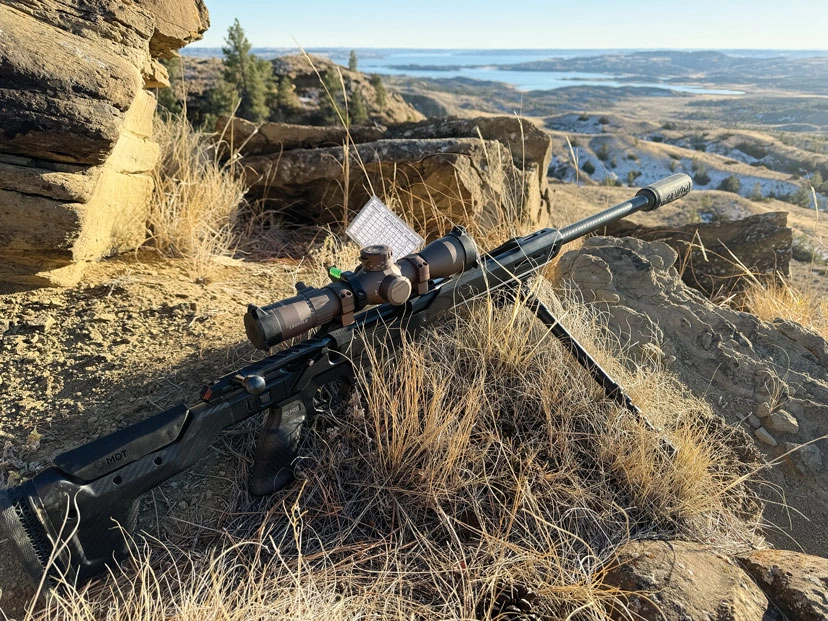
George Krumm’s custom 7 PRC has an MDT HNT26 Chassis, Aero Precision SOLUS Lightweight Long Action, Oregon Mountain Rifle 22” carbon-fiber barrel, Hatch Out West bipod, Leupold Mark 5HD 3.6-18x44 scope, and Silencer Central’s BANISH Backcountry suppressor.
Do Suppressors Reduce Recoil?
Just a few years ago, many people I talked to claimed that suppressors don’t reduce recoil. Having shot a few different rifles both suppressed and unsuppressed, I disagree. They definitely reduce recoil, but not to the extent that muzzle brakes do. Here are some examples for perspective. I shot my 6.5 PRC with a Q Trash Panda suppressor in a NRL Hunter match last spring. Shots ranged from about 235- to over 900 yards. Most shots were between 400- and 600 yards. The 6.5 PRC is a magnum cartridge; certainly, it doesn’t recoil as much as a .300 Win Mag, but it still has a pretty good jolt if you shoot it without a muzzle device. At the match, I was able to see my hits and misses through my scope most of the time. I think it would have been tough without the suppressor or a brake on the rifle. A second example where I experienced a significant reduction in recoil was with my new, custom 7 PRC I built with an Oregon Mountain Rifle carbon-fiber barrel on an MDT HNT26 chassis. The 7 PRC has a few more foot-pounds of recoil than my 7mm Rem Mag. With the 7mm Rem Mag, plain barrel, after about 15 shots I start to feel that unpleasant twinge in my shoulder where I know continued shooting is about to head into the un-fun realm. With a BANISH Backcountry suppressor on my 7 PRC, I can shoot 25- or 30 shots before I start noticing any sort of twinge at all.
How much of a reduction in recoil you get from a suppressor depends on several factors, like caliber, load, rifle weight, and the suppressor you choose. Jim Harmer of Backfire.tv says you can expect recoil reduction of about 35% with a BANISH Backcountry. That is significant.
Direct-Thread Suppressors and Accuracy
There are many ways to connect a can to your rifle. Different brands have different adaptors, and it can get confusing. For hunters, I think the best way to go is to get direct-thread suppressors. The hunting-rifle standard threads in the US seems to be 5/8 x 24 for most big-game rifles. If you buy one direct-thread, .30 caliber can with 5/8 x 24 threads, you can use it on any rifle that has 5/8 x 24 threads, whether it’s a .300 PRC or a 6.5 Creedmoor or even smaller.
Suppressors seem to improve the accuracy of some rifles; but not all rifles. It may have something to do with gas being trapped in the can as the bullet uncorks. At the very least, none of the rifles I’ve shot unsuppressed, then suppressed, exhibited a decrease in accuracy.
If you decide you want to shoot a rifle un-suppressed, it only takes a few seconds to unscrew a suppressor to remove it.
Overall, the suppressed shooting experience is much more pleasant than shooting either a naked rifle or a braked rifle.
Suppressor Disadvantages
Suppressors do have some drawbacks to consider. First, they are not inexpensive. An inexpensive .30 caliber suppressor might cost $650. An expensive one might cost $1,300 or more. What’s more, you have to buy a federal tax stamp which is $200 for every suppressor you buy.
This leads us to the second- and third drawbacks: paperwork and time. You’ll have to fill out a Bureau of Alcohol, Tobacco, Firearms and Explosives (ATF) form 4 to apply for a suppressor, which has to get processed and involves a background check. If you fill out an Individual form 4, approvals from the ATF are pretty fast—days to weeks. But if you want to be able to hand a suppressor down to your kids, you’ll need a Trust. Approvals for form 4s with Trusts are still taking several months. My last one took about six months. The paperwork is tough to figure out on your own. Some gun shops have kiosks to help you with the paperwork, and those that do will walk you through it. Other options include buying through Silencer Central, SilencerShop, or SilencerCo. I have purchased through all three and they all made it easy for me. The hard part was waiting for months for the paperwork to be approved. I like the fact that Silencer Central ships it right to your door once everything has been approved. With SilencerShop and SilencerCo, you’ll have to pick your suppressor up at one of their dealers, of which there are hundreds around the country.
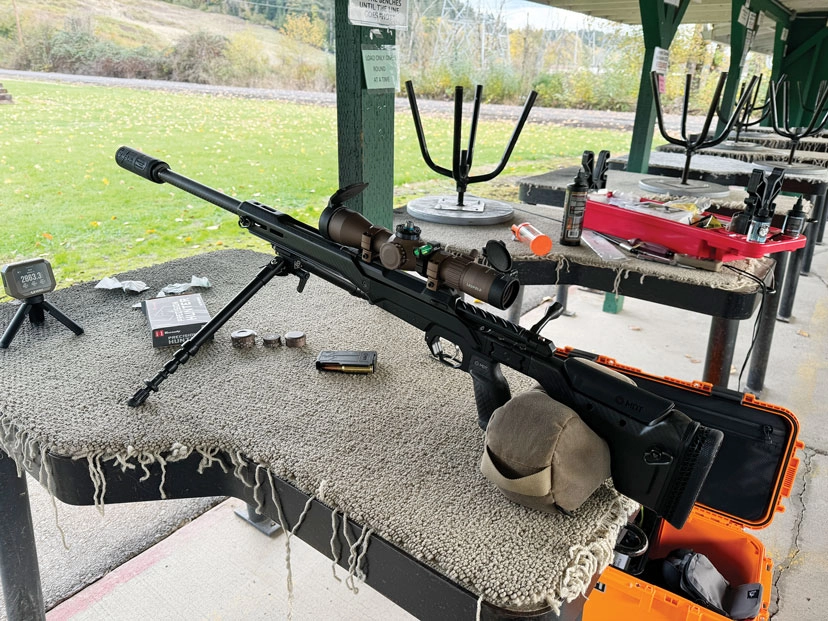
Silencer Central’s BANISH Backcountry is an excellent hunting suppressor at just 5.5” long and a little over 7 ounces. It will work for calibers up to .300 RUM.
Added Length and Weight
Suppressors add length and weight to your rifle. They’ve come a long way in the past decade, and now the suppressors most suited to hunting are short, titanium cans that weigh from around 7 ounces up to 13 ounces or so. I own three .30 caliber suppressors: A BANISH Backcountry, direct thread, 5.5” long and it weighs 7.2 ounces; A SilencerCo Omega 300 DT which is 6.98” long and weighs 12.6 ounces; and a Q Trash Panda, which is 6.91” long and weighs 11.8 ounces. The Trash Panda is not a direct-thread suppressor, so you have to also buy the Q Cherry Bomb muzzle brake. You first screw the Cherry Bomb onto your barrel, and most folks use Rocksett or Red Loctite to secure it. Then, screw the Trash Panda onto the Cherry Bomb hand-tight. The Cherry Bomb weighs two ounces, so combined with the Trash Panda, it adds 13.8 ounces to my rifle. Regarding the Trash Panda, which was my first suppressor, if I could do it over, I would buy the Q Half Nelson, which is the direct-thread equivalent of the Trash Panda. The Half Nelson weighs 12.2 ounces. Again, for hunting applications I think direct-thread suppressors are the way to go.
Carrying a Suppressed Rifle in the Field
You might wonder, how much does this extra length and weight affect you in the field? My experience is that it doesn’t affect you all that much. Others will disagree, and there are a large number of people building rifles with short barrels so they can shoot them suppressed and carry them in the field without having such a long weapon. I suppose shorter is better when it comes to making your way through Alaskan alder jungles, but I just haven’t noticed 5.5- to 7 inches of additional length being much of an issue, and as for the weight, it actually seems to make some of my rifles balance better.
Resale and Re-Zeroing
Another major disadvantage to suppressors is you can’t legally re-sell one. So, choose carefully before you pull the trigger on one. It’s a sizeable expense, and you’ll want to be sure you get one you’ll be happy with. Talk to other suppressor owners and get their feedback before you buy. If possible, go watch them shoot at the range to see what it sounds like, and how you attach and remove it.
When you add a suppressor to a rifle that you previously zeroed unsuppressed, you will have to re-zero. When you put the suppressor on, your point of impact at 100 yards is going to shift. In my experience, my point of impact shifted about two inches with the Trash Panda and a little less with the Omega 300 DT. The good news is once you zero the rifle with the suppressor, you can remove the suppressor and reattach it without your point of impact shifting again. I’ve attached and removed my Trash Panda from my 6.5 PRC many times and when I put the suppressor back on, the point of impact is the same as it was the last time I put the suppressor on. Same experience with the BANISH Backcountry/7 PRC combo. Note that if I were to put the Omega 300 on either the 6.5 PRC or the 7 PRC, I would probably have a point-of-impact shift, because it’s a different suppressor than what I had zeroed with.
Heat and Mirage
A final drawback of suppressors is that they get really hot, and mirage can be a problem at the range. The more powder being burned, the hotter they get. My 7 PRC heats up a can a lot faster than my 6.5 PRC because the 7 PRC is burning quite a bit more powder. This mirage generally won’t happen while hunting because we’re not firing a lot of rounds. But it will probably happen at the range. A suppressor cover helps diffuse mirage, and it also prevents you from burning yourself on the hot suppressor. I like the Weka MOA STEALTH covers. They are made of silicone, come in two diameters, and three colors. Even with the cover, if I shoot enough rounds in a relatively quick sequence, mirage will appear and you can’t shoot very accurately if mirage is bad enough. You’ll have to wait several minutes for the suppressor to cool down.
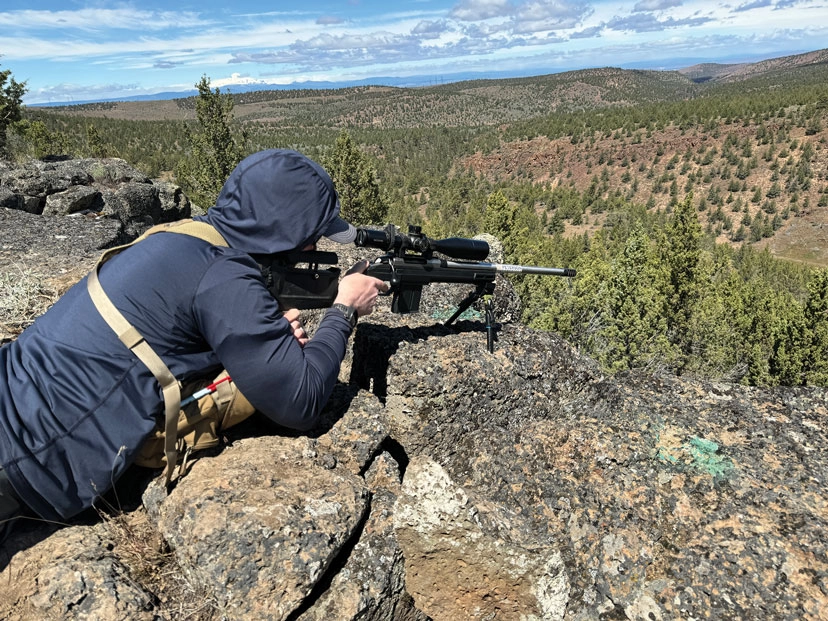
Most competitors in PRS and NRL Hunter matches use muzzle brakes because of the tremendous reduction in recoil which enables them to spot their hits and misses.
Muzzle Brake or Suppressor: The Verdict
Muzzle devices are here to stay. Because they reduce recoil, they help hunters spot their impacts or misses, which provides the hunter with critical information for follow-up shots. Muzzle brakes reduce recoil more than suppressors, but are extremely loud and will damage your hearing (and possibly, those around you) if you shoot without hearing protection. Suppressors don’t reduce recoil as much as muzzle brakes, but they are much quieter than plain-barreled or braked rifles, and game seems to have a hard time recognizing where a suppressed shot came from.
Having shot with both systems, the jury in this hunter’s mind has come back from deliberation and has spoken. I will shoot suppressed whenever possible from this point forward because suppressors make the shooting experience much more pleasant. Rifles that I have which are not threaded, will get threaded. Muzzle brakes will be removed so I can shoot those rifles suppressed. Most hunters I’ve talked to who shoot suppressed say they’ll never shoot any other way if they have a choice. I feel the same way.
Tips for Buying Your First Hunting Suppressor
- Talk to other hunting-suppressor owners to learn what works.
- Focus on direct-thread suppressors that are made of titanium.
- .30 caliber suppressors can be used on rifles up to the .300 magnums. You can use a .30 caliber suppressor on a 6.5 Creedmoor or other small caliber as long as the threads match.
- If you are shooting something larger than .30 cal, look at suppressors that are designed for the caliber you’re shooting.
- You do not need a full-auto-rated suppressor for hunting. They are usually heavier, and they sometimes cost more.
- Order though a dealer who carries the brand and model of suppressor you want, or order through Silencer Central, SilencerCo, or SilencerShop. They have cracked the code on making it relatively easy to buy suppressors. They can answer any questions you might have, and they will make the process easy for you.
- If you want the suppressor mailed to your door, use Silencer Central.
About the Author George Krumm

George Krumm is the Editor of both Fish Alaska and Hunt Alaska magazines. He is also a freelance writer/photographer. George has fished and hunted from Patagonia to Alaska and has been writing professionally since 2003. George writes several feature articles per year for various publications, plus he writes the “Editor’s Creel” and “Flyfishing” columns for Fish Alaska magazine, and he wrote the “Stillwater” (flyfishing) column in Fish Alaska for more than nine years. George lived in Alaska for 20 years and now makes his home in the Pacific Northwest.
Find more reading at Hunt Alaska’s Blog Archive.